A graph showing concentrated liquidity ranges vs. traditional constant product pools

Why Liquidity Pools Are the Heartbeat of DeFi Trading (and How to Trade Them Smarter)

Short version: liquidity pools power most decentralized exchanges, and they can make you money — or take it away fast. Wow! The more you trade around them, the more you notice small things that add up; fees, depth, tick spacing, and human behavior all matter. Initially I thought liquidity was just “how much money’s in a pool,” but then I realized that’s too simple — it’s about distribution, price ranges, and incentives that shift every hour.

Okay, so check this out — liquidity pools (LPs) are automated market makers’ backbone. Seriously? They replace order books with math that prices assets based on reserves. My instinct said, “this is elegant,” and that feeling still holds, though there are rough edges. On one hand LPs democratize market making; on the other hand they introduce concentrated risk that many traders don’t fully appreciate. Here’s what bugs me about how discussions often go: people talk about APY like it’s guaranteed income. It’s not.

Let’s walk through the practical stuff. Whoa! Pool depth matters first. If a pool has low depth, your trades will face huge slippage. Medium-depth pools can be OK for small trades, though actually if the pair is volatile you’ll still pay for it. Larger pools buffer price impact, but that doesn’t immunize providers from impermanent loss — it’s just a slower burn.

Concentrated liquidity changed the game. Hmm… Uniswap v3-style positions let LPs choose price ranges and concentrate capital to get higher fees per dollar deployed. That sounds great, right? Initially I imagined everyone would rake in fees, but reality’s messier. Liquidity concentrated too tightly means you’re effectively making a directional bet; if price escapes your range, your position sits in one asset and stops earning fees. I’m biased toward diversified ranges when I’m not actively managing positions.

Fees are where traders and LPs intersect. Seriously? Every swap pays fees to LPs, and fee tiers can make or break returns. High-fee pools protect LPs from impermanent loss more, but they also reduce swap volume because traders prefer cheaper routes. On the flip side, low-fee pools attract volume but dilute LP reward per trade. There’s trade-offs — literally.

A graph showing concentrated liquidity ranges vs. traditional constant product pools

Practical trading mindset — what traders on DEXs actually need to know

First, think like both trader and LP. Whoa! That dual perspective helps. As a trader you care about slippage, routing, and MEV risk. As an LP you care about exposure and rebalancing frequency. Initially I thought they were separate careers, but actually the best active traders I know treat LP returns like illiquid position hedges.

Routing matters. Hmm… Smart routers will split trades across pools and chains to minimize slippage and fees. If you’re swapping a big chunk, check depth and the number of hops the router plans to use. Multi-hop routes can save on slippage but introduce MEV and front-running risks. I’m not 100% sure our ecosystem has nailed MEV mitigation yet — it’s getting better, but somethin’ still feels off.

Watch for price oracles and manipulation vectors. Whoa! Flash loans can rotate prices in small pools in seconds. That can trap traders using naive slippage tolerances, and it can wipe LPs if positions are tightly concentrated. So when you see a suspiciously juicy APY, ask: where’s the volume coming from? Is it organic demand or a handful of bots running loops?

Don’t ignore composability. Seriously? Liquidity pools never live alone — they’re part of lending, yield farms, and overlay strategies. That means systemic risk can cascade. On one hand composability creates strong utility; on the other hand it creates complex failure modes that most dashboards won’t surface. I like tools that show cross-protocol exposures; use them.

Impermanent loss deserves a clear, plain treatment. Hmm… It’s not “loss” until you withdraw and realize the position compared to HODLing, but it’s real economics. If price moves a lot from your deposit ratio, you miss out on gains compared to just holding. Fees offset that sometimes, but not always. The math is simple; the human part — deciding when to rebalance or exit — is the hard bit.

So how do you trade LPs smarter? Whoa! A few rules of thumb that have saved me time and capital: pick pools with steady organic volume for passive LPing; use wider ranges if you can’t actively monitor positions; consider stable-stable pools for low volatility exposure; avoid super low TVL tokens unless you understand the community and flows. Also — and this is big — rotate strategies with the market. I’m biased toward being active in volatile markets and passive when things are quiet.

Practical checklist before you deposit: Wow! Check TVL, fee tier, recent 24h volume, token volatility, and largest holders. Yes, check contracts and audits. No, audits aren’t guarantees. Look at recent on-chain flows (are there whale deposits or withdrawals?). If you can, simulate outcomes — many interfaces show impermanent loss curves and projected fees at different volumes. Use them, but don’t trust them blindly.

Tools and workflows I use (and why)

When I scout pools, I start with route analysis tools and on-chain explorers. Whoa! It’s fast to see if a router is sending your trade through five tiny pools or one big pool. For LP management I keep a spreadsheet tracking ranges, cost basis, and realized fees. Yes, it’s manual — but it forces discipline. On nights when markets get wild I set alerts for range breaches. That saves me from waking up to unpleasant surprises.

One tip — try the dapps that let you visualize concentrated positions and expected fee income under different volatility regimes. Seriously? Seeing the distribution helps you intuitively understand risk. Also, if you want a place to start exploring pools and routing UX, check out aster dex for a clean interface and handy visual tools. I’m not shilling — I just like that their UX reduces dumb mistakes for traders and LPs alike.

Leverage and LP tokens: Hmm… Be careful. Leveraged LP strategies amplify both fees and IL. Borrowing to provide liquidity can be profitable in sideways markets but devastate you on directional moves. If you’re running leverage, set stop conditions and have an exit plan. Simple as that.

FAQ — quick answers traders ask a lot

Q: Is impermanent loss avoidable?

A: Not entirely. Whoa! You can reduce it with stable-stable pools, balanced LPing, or by concentrating liquidity across wide ranges, but you trade off fee income. Active management and hedging strategies (like options or short positions) can mitigate it, though those add complexity.

Q: How do I pick fee tiers?

A: Pick fee tiers based on expected volatility and trade size. Seriously? For volatile tokens, favor higher fees; for stable pairs, lower fees will attract volume. Check historical swap sizes — if most swaps are tiny, a high fee tier will scare volume away.

Q: Can I be both trader and LP at the same time?

A: Yes. Wow! Many pros alternate roles based on market regime. When volatility spikes I might concentrate liquidity for quick fee capture and then switch to passive wide-range LPing as things calm. It requires attention and good tooling.

Final thought — markets evolve. Hmm… Protocol designs iterate, routers get smarter, and LP strategies that worked last year might be obsolete tomorrow. I’m not 100% sure any single approach is evergreen. What I do know is this: marry on-chain data with common sense, keep an eye on flows and concentration, and don’t get seduced by headline APYs without understanding the source. It’s messy, it’s exciting, and if you’re careful you can play it to your advantage.

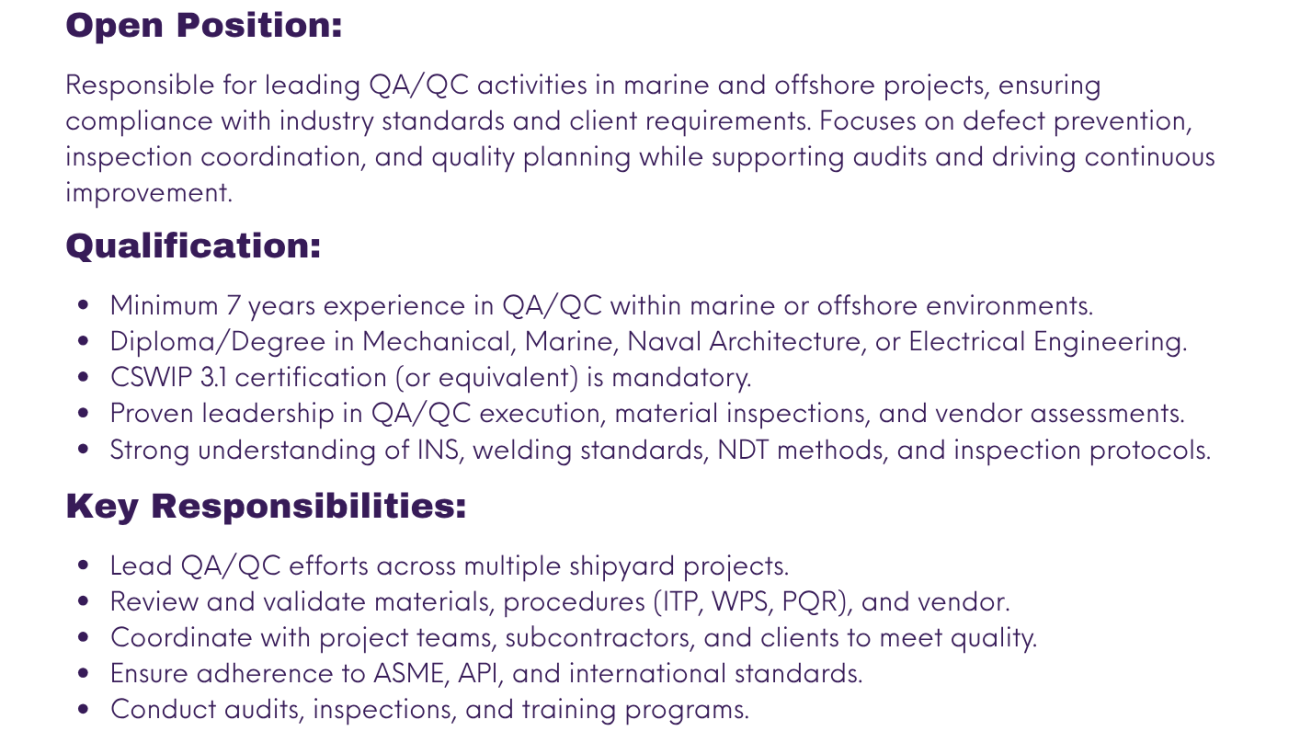
Hiring Senior QSA Engineer

Hiring Senior QSA Engineer

Hiring Senior QSA Engineer for Marine & Offshore Projects – Qatar Opportunity

Join MANCON International’s Skilled Workforce in the Gulf!

Are you an experienced QA/QC professional with expertise in marine and offshore projects? MANCON International is urgently hiring a Senior QSA Engineer to lead quality assurance and control initiatives in Qatar.

This is a high-impact role for a leader who ensures compliance with international standards, drives defect prevention, and enhances project quality. If you have 7+ years in QA/QC and a background in marine/offshore engineering, this could be your next career-defining opportunity.


Job Overview

Position: Senior QSA Engineer
Location: Qatar (Onsite)
Industry: Marine & Offshore Construction

Key Responsibilities:

✔ Lead QA/QC activities across multiple shipyard projects.
✔ Review materials, procedures (ITP, WPS, PQR), and vendor compliance.
✔ Ensure adherence to ASME, API, and international standards.
✔ Conduct audits, inspections, and training programs for teams.
✔ Drive continuous improvement through lessons learned and defect prevention.


Qualifications & Requirements

✅ Education: Diploma/Degree in Mechanical, Marine, Naval Architecture, or Electrical Engineering.
✅ Certification: CSWIP 3.1 (or equivalent) is mandatory.
✅ Experience: Minimum 7 years in QA/QC within marine/offshore environments.
✅ Technical Skills:

  • Strong knowledge of welding standards, NDT methods, and inspection protocols.
  • Experience in material inspections and vendor assessments.
  • Ability to coordinate with clients, subcontractors, and project teams.

Why Join MANCON?

We offer an attractive expatriate package with exceptional benefits:

✈ Family Status Visa (covers spouse + 3 children under 18)
✈ Annual Flight Tickets for family
🏥 Comprehensive Medical Insurance
💰 Industry-Competitive Salary & Growth Opportunities


How to Apply?

If you meet the qualifications and are ready for a challenging yet rewarding role, submit your application today!

📧 Email CV: careers@manconint.com
🌐 Website: www.manconint.com
📱 WhatsApp: +92 370-815-6008

Hiring is Immediate – Apply Now!


Share This Opportunity!

Know someone perfect for this role? Tag or share this post with QA/QC professionals in your network!

🔗 #Hiring #QAQC #MarineEngineering #OffshoreJobs #QatarJobs #SeniorEngineer #MANCONJobs


MANCON International Pvt. Ltd.
Building Excellence in the Gulf Workforce
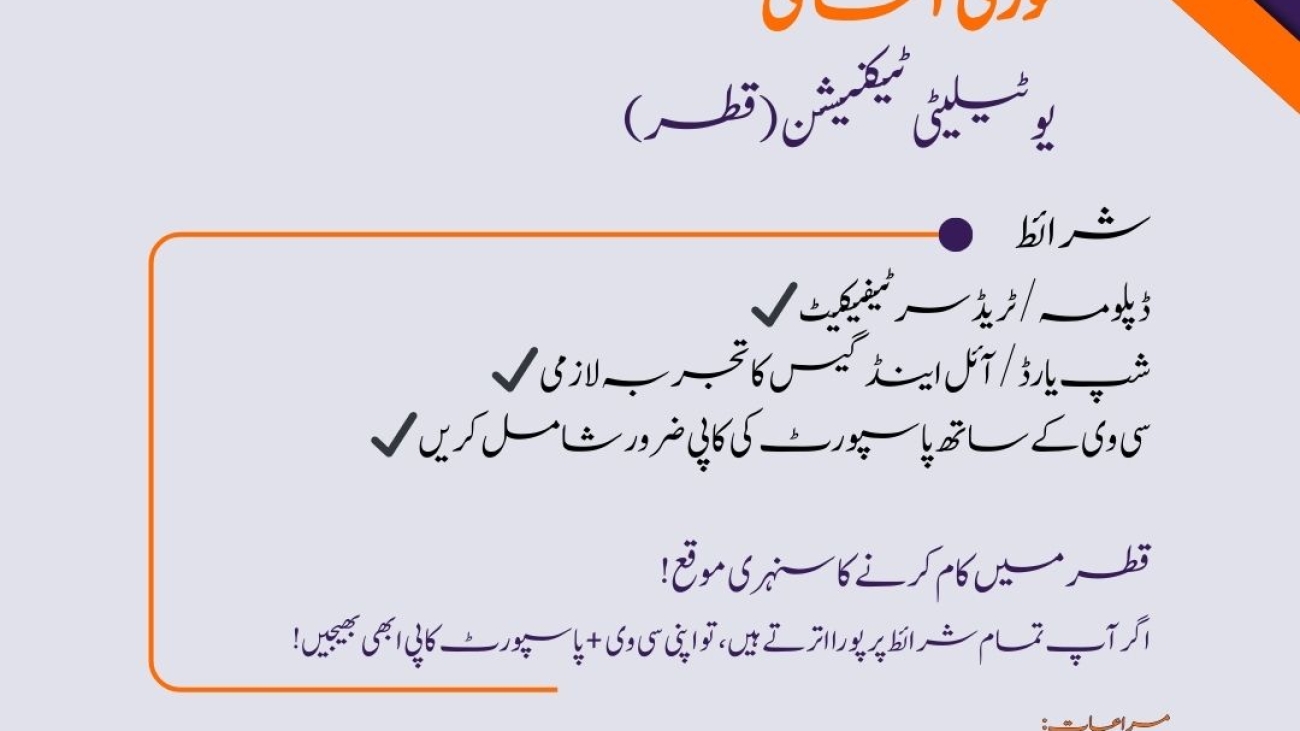
Urgent Hiring – Utility Technician (Qatar)

Urgent Hiring – Utility Technician (Qatar)


Job Description:
We are looking for experienced Utility Technicians to join our team in Qatar.

Requirements:

  • Minimum 6 years of experience in relevant field
  • Strong technical skills and ability to troubleshoot utility systems
  • Knowledge of maintenance and repair procedures

Benefits:

  • Daily wages
  • Free accommodation
  • Free transportation

How to Apply:
📧 Email: careers@manconint.com
🌐 Website: www.manconint.com
📱 WhatsApp: +92 370-815-6008

Diagram: hardware wallet signing flow for derivatives positions

Why Hardware Wallet Support Matters for Derivatives Trading and Yield Farming

Whoa! This whole space moves fast. My instinct said “cold storage first,” but then I watched a friend nearly liquidate a position because their keys were scattered across apps. Seriously? Yeah. Here’s the thing. Managing margin, leverage, and stacked yield on multiple chains feels like juggling live chainsaws. You want security, but you also want to act—fast.

So let’s talk practical trade-offs. Hardware wallets give you air-gapped signing and far fewer attack vectors than software-only setups. That matters when you are opening derivative positions where an automated liquidation can wipe your equity in minutes. Initially I thought people only used hardware wallets for simple HODL scenarios, but then I watched developers wire up Ledger and Trezor flows into trading pipelines—proof that the old mental model is outdated. On one hand hardware devices slow down UX; on the other hand they give you a layer of defense that automated margin systems respect. Hmm… it’s not complicated, though actually it is—because the integrations have to be handled carefully.

I’ll be honest: I’m biased toward devices that force a physical confirmation. This part bugs me: too many platforms pretend they have “secure custody” when they really mean “we store your keys on an HSM in a cloud somewhere.” I’m not comfortable with that. (oh, and by the way…) If you want to trade derivatives while keeping custody, you need a wallet and an exchange that play nice together.

Check this out—

Diagram: hardware wallet signing flow for derivatives positions

How hardware wallets actually work with trading flows

Short version: signing happens on the device. The rest runs on software. The long version is messier. Wallet apps build the transaction payload, you review it, and then the device cryptographically signs it. With derivatives there are two complications: non-standard transaction formats for some protocols, and the need to sign repeated messages for approvals or margin adjustments. So you want a wallet that supports multi-sign and smart contract interactions without circumventing the hardware device. That’s why wallet choice matters.

If you’re exploring options that combine custody and exchange access, consider solutions that integrate natively with exchanges or provide a seamless WalletConnect/extension bridge to trading platforms. I’ve been poking around and recommend checking the Bybit offering as a place to start—especially if you value an integrated experience while retaining custody for critical keys. See the bybit wallet for one example of how exchange-linked wallets can be organized.

Let me unpack three core areas: security, derivatives-specific risks, and yield farming mechanics.

Security first: practical habits that actually work

Keep seed phrases offline. Period. Sounds obvious, but people still screenshot them. Don’t. Really. Use a metal backup for your seed phrase if you care about fire and water. Use a hardware wallet for signing high-value transactions. Use a different, low-balance hot wallet for gas and quick ops. My workflow: hardware for vault-level assets, hot wallet for day trades. Initially that felt cumbersome, but over months it became a reliable pattern and saved me from a few phishing attempts.

Multi-sig is underrated. Two-of-three signers across devices or custodians limits single-point failures. For teams or high-net accounts, multi-sig is often the single best improvement over a lone hardware device. But be careful: multisig increases operational complexity during liquidations or margin calls—another trade-off.

Also, watch approvals. Approving unlimited allowances to DeFi contracts is still common and still dumb. Revoke allowances regularly. Consider time-bound approvals for strategies that run autonomously.

Derivatives trading: latency, liquidations, and custody puzzles

Derivatives bring latency sensitivity. A hardware signature step can add seconds to trade execution. Seconds matter when funding rates swing or when an oracle update changes position health. That said, you can design around it. For example, keep small slippage-tolerant positions on hot wallets and reserve hardware confirmations for large, strategic trades. On one hand you accept some exposure to speed risk; on the other you avoid giving full custody rights to a third party.

Funding rates, margin calls, and insurance funds—those are the levers to watch. Derivative platforms vary in how they allow off-chain order creation and on-chain settlement. If your exchange requires on-chain settlement for certain actions, hardware signing becomes crucial. If settlement is off-chain with exchange custody, then you need to evaluate counterparty risk instead. Balance the math: what do you risk losing to a hack versus a sudden market move?

Yield farming: orchestration across chains and contracts

Yield farming is not a guaranteed path to riches. Impermanent loss still bites. Smart contract bugs still happen. But you can reduce a lot of tail risk by combining hardware wallet custody with careful strategy design. Use the device to sign approvals and only commit capital to audited pools. Keep an eye on TVL migrations and rewards that vanish overnight when incentives change. I’m not 100% sure about future incentive models, but I know patterns—farms spike then drop when LP incentives dry up.

Automation tools—bots, harvesters, rebalancers—are great, but they require approvals and often a hot wallet with enough permissions to act autonomously. Again, trade-offs. You either accept automation with permission granularity, or you keep manual control with a hardware wallet and sacrifice some yield efficiency.

Practical checklist before you bridge accounts and stack strategies

– Confirm hardware wallet compatibility with the chains you use. EVMs, Solana, and others each have nuance. Some wallets emulate accounts or use different signing schemes. Not all hardware devices support every chain equally well.
– Use watch-only accounts for monitoring. They let you track positions without exposing keys.
– Limit allowance sizes and use pull-based payments where possible.
– Test small. Send micro-transactions before moving large sums. Very very important.
– Practice emergency procedures: how to sign an emergency close? Who has a multisig key? Where are backups stored? These answers save you in stress moments.

FAQ

Can I trade derivatives directly from a hardware wallet?

In many cases yes, but with caveats. If the derivative platform supports on-chain settlement using EOA-style transactions you can sign from a hardware device. If the exchange uses off-chain matching and custodial settlement, the hardware wallet may only serve as a safety anchor (withdrawals, custody verification). Always test with small positions first and read the platform’s doc for signing flows.

Does using a hardware wallet stop me from yield farming?

No. You can use hardware wallets to sign approvals and deposits to farms. The friction is in repeated harvests and in any automated strategies that need ongoing rights. For those, consider a hybrid approach: keep long-term funds under hardware custody and maintain a smaller, permissioned hot wallet for automation tasks.

What are the main risks when combining hardware wallets with exchange-linked wallets?

Speed and UX friction are the top two. There’s also interoperability: not every exchange or wallet supports direct hardware signing for all operations. Counterparty risk still exists if the exchange holds settlement off-chain. Finally, human error—misconfiguration, lost backups, misplaced devices—remains a dominant failure mode. Prepare for that.

Recruiting for qatar (2)

Mancon International Recruiting For Senior Systems Analyst (logistics)

 MANCON INTERNATIONAL PVT LTD.
SKILLED WORKFORCE FOR GULF

RECRUITING FOR INFORMATION TECHNOLOGY
Location: Doha / Ras Laffan, Qatar
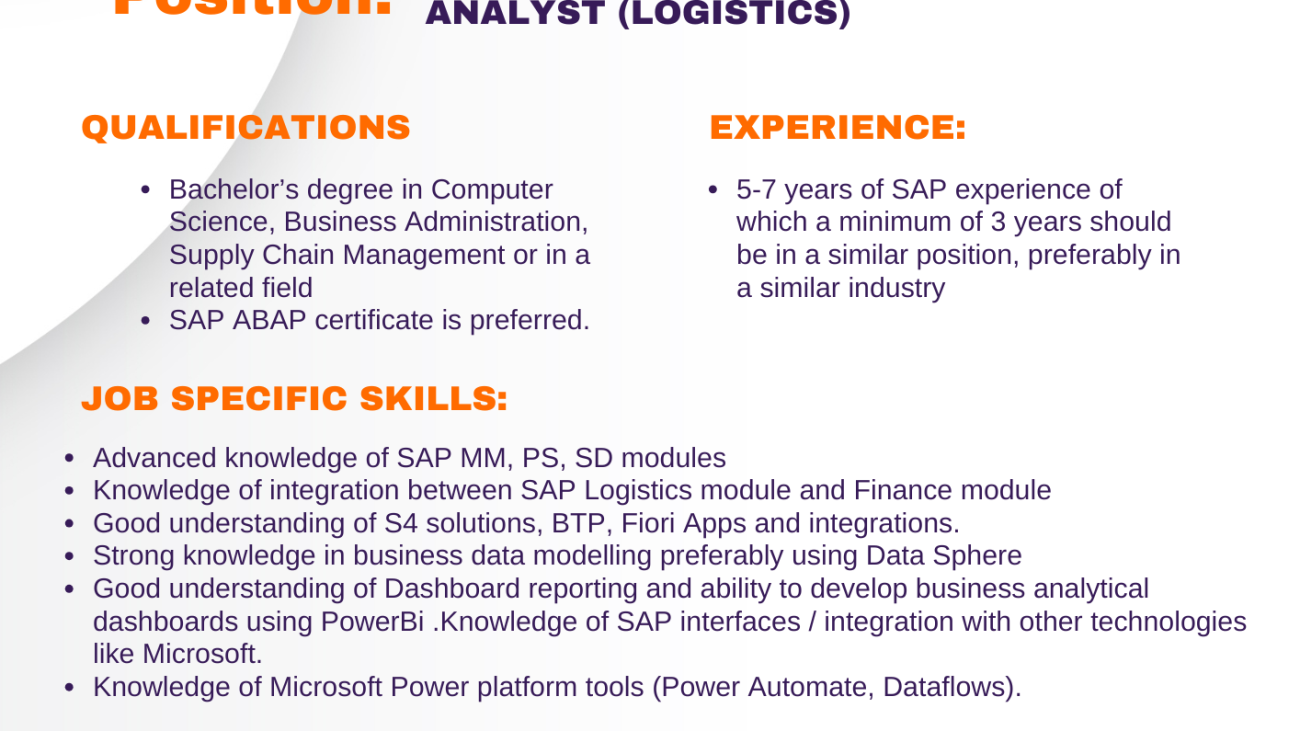
Position: Senior Systems Analyst (Logistics)


QUALIFICATIONS

  • Bachelor’s degree in Computer Science, Business Administration, Supply Chain Management or related field
  • SAP ABAP certification (preferred)

EXPERIENCE

  • 5-7 years of SAP experience (minimum 3 years in similar role)
  • Industry experience preferred

TECHNICAL EXPERTISE
SAP Logistics Specialization:

  • Advanced knowledge of SAP MM, PS, SD modules
  • SAP Logistics-Finance module integration

Digital Transformation Skills:

  • S4 solutions, BTP, Fiori Apps and integrations
  • Business data modeling (Data Sphere preferred)
  • Dashboard development (Power BI)
  • SAP-Microsoft technology integrations

Automation Tools:

  • Microsoft Power Platform (Power Automate, Dataflows)

Professional Skills:

  • Strong analytical capabilities
  • Cross-module integration expertise
  • Business intelligence implementation

COMPREHENSIVE BENEFITS

  • 100% Tax-Free Salary Package
  • Housing & Transportation Allowances
  • Generous Annual Leave with Airfare
  • Global Health Coverage
  • Children’s Education Support

APPLICATION PROCESS
Email: careers@manconint.com
WhatsApp: +92 370-815-6008

Advance your logistics technology career with our Qatar-based international team!

Recruiting for qatar

Mancon International Recruiting For Senior Systems Analyst (HR)

 MANCON INTERNATIONAL PVT LTD.
SKILLED WORKFORCE FOR GULF

RECRUITING FOR INFORMATION TECHNOLOGY
Location: Doha / Ras Laffan, Qatar
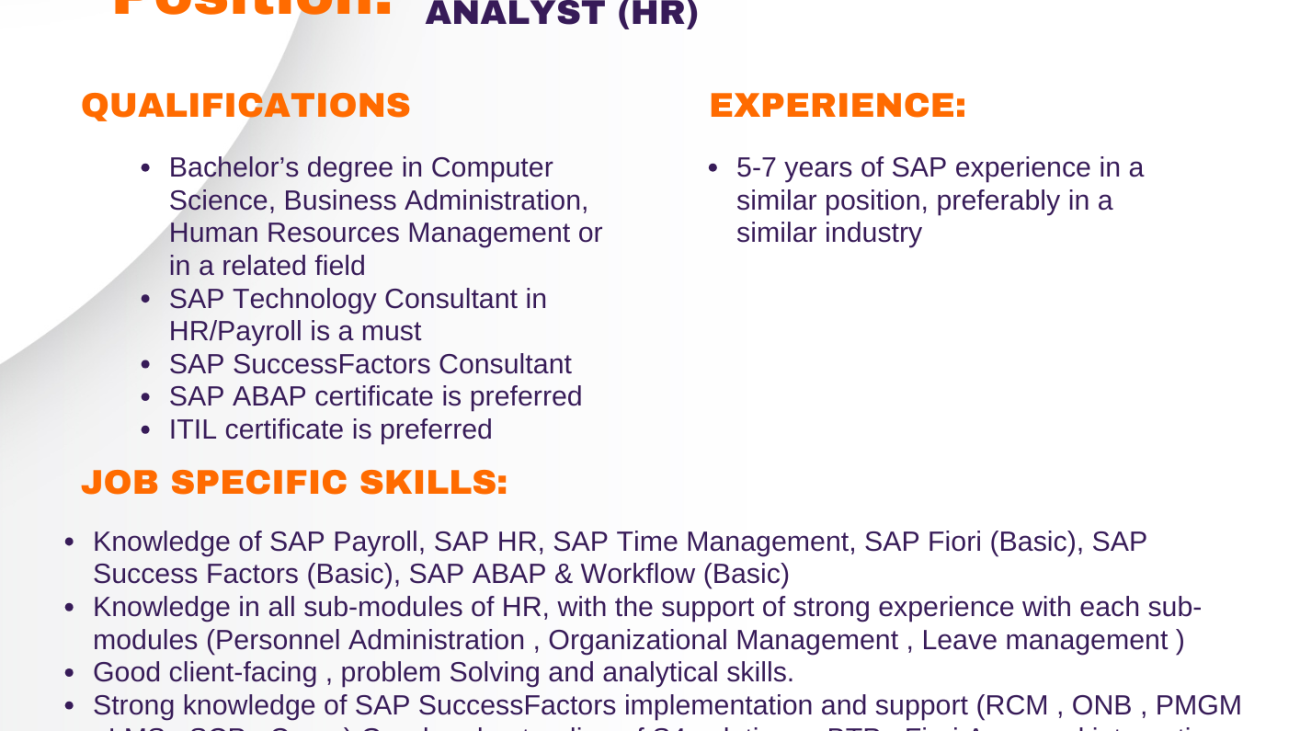
Position: Senior Systems Analyst (HR)


QUALIFICATIONS

  • Bachelor’s degree in Computer Science, Business Administration, Human Resources Management or related field
  • SAP Technology Consultant certification in HR/Payroll (required)
  • SAP SuccessFactors Consultant certification
  • SAP ABAP certification (preferred)
  • ITIL certification (preferred)

EXPERIENCE

  • 5-7 years of SAP experience in a similar role
  • Industry experience preferred

JOB-SPECIFIC SKILLS
Core SAP HR Expertise:

  • SAP Payroll, SAP HR, SAP Time Management
  • SAP Fiori (Basic), SAP SuccessFactors (Basic)
  • SAP ABAP & Workflow (Basic)
  • All HR sub-modules:
    • Personnel Administration
    • Organizational Management
    • Leave management

Technical & Analytical Skills:

  • SAP SuccessFactors implementation and support (RCM, ONB, PMGM, LMS, SCP, Comp)
  • S4 solutions, BTP, Fiori Apps and integrations
  • Business data modeling (Data Sphere preferred)
  • Dashboard reporting (Power BI)
  • SAP-Microsoft integrations
  • Microsoft Power Platform (Power Automate, Dataflows)

Soft Skills:

  • Strong client-facing abilities
  • Excellent problem-solving skills
  • Analytical mindset

BENEFITS PACKAGE

  • 100% Tax-Free Salary
  • Housing Allowance
  • Transportation Allowance
  • Generous Annual Leave with Paid Airfares
  • International Health Insurance
  • Free Education for Children

HOW TO APPLY
Email: careers@manconint.com
WhatsApp: +92 370-815-6008

Join our team in Qatar and advance your career with a leading international organization!

Recruiting for qatar (1)

Mancon International Recruiting For Senior Systems Analyst (Finance)

 MANCON INTERNATIONAL PVT LTD.
SKILLED WORKFORCE FOR GULF

RECRUITING FOR INFORMATION TECHNOLOGY

Location: Doha / Ras Laffan, Qatar
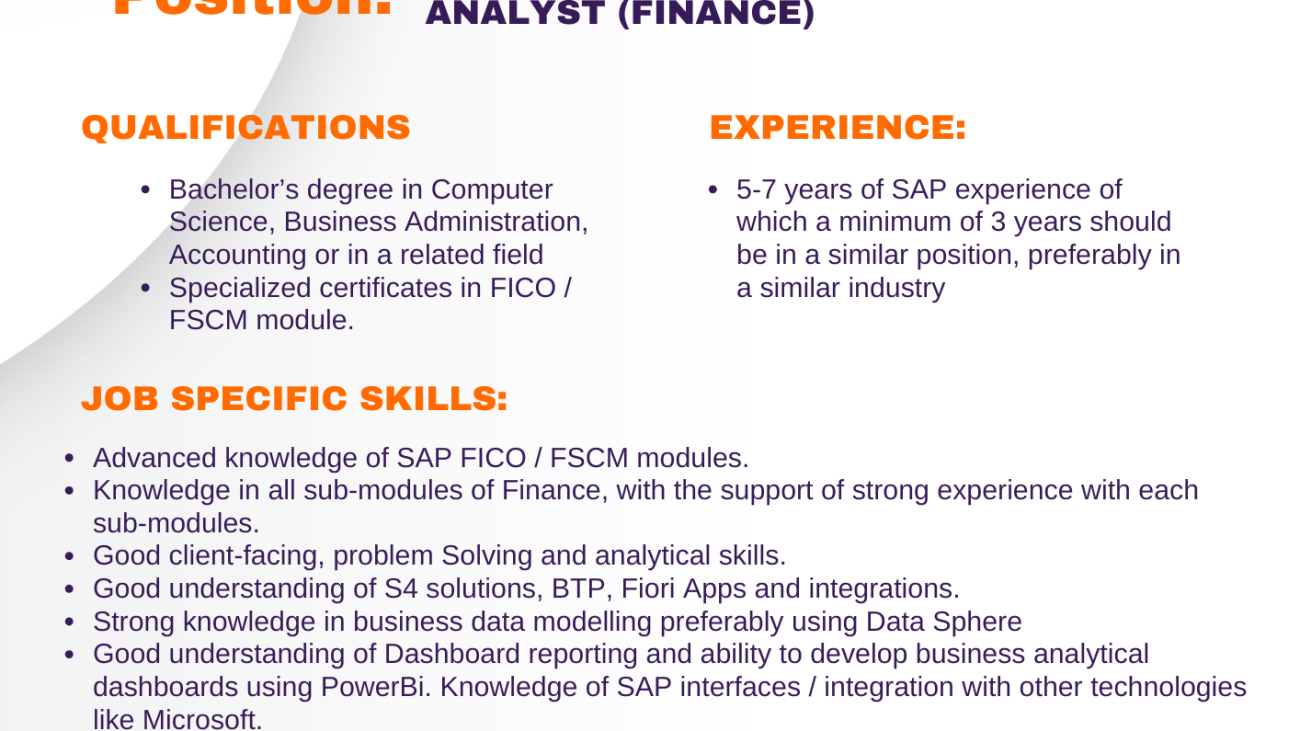
Position: Senior Systems Analyst (Finance)


QUALIFICATIONS

  • Bachelor’s degree in Computer Science, Business Administration, Accounting, or a related field.
  • Specialized certificates in SAP FICO/FSCM modules.

EXPERIENCE

  • 5–7 years of SAP experience, with at least 3 years in a similar role.
  • Preference for candidates from similar industries.

JOB-SPECIFIC SKILLS

  • Advanced expertise in SAP FICO/FSCM modules and all finance sub-modules.
  • Strong client-facing, problem-solving, and analytical skills.
  • Proficiency in S4 solutions, BTP, Fiori Apps, and system integrations.
  • Business data modeling (preferably using Data Sphere).
  • Dashboard reporting (e.g., Power BI) and SAP-Microsoft integrations.
  • Knowledge of Microsoft Power Platform tools (Power Automate, Dataflows).

BENEFITS

  • 100% Tax-Free Salary
  • Housing Allowance
  • Transportation Allowance
  • Generous Annual Leave with Paid Airfares
  • International Health Insurance
  • Free Education for Children

HOW TO APPLY

Email: careers@manconint.com
WhatsApp: +92 370-815-6008

Apply now to join a dynamic team in Qatar!

Recuitin fo qatar

Mancon International RECRUITING FOR SCHOOLOGY SHIPYARD SOLUTIONS

RECRUITING FOR SHIPYARD
SCHOOLOGY SOLUTIONS

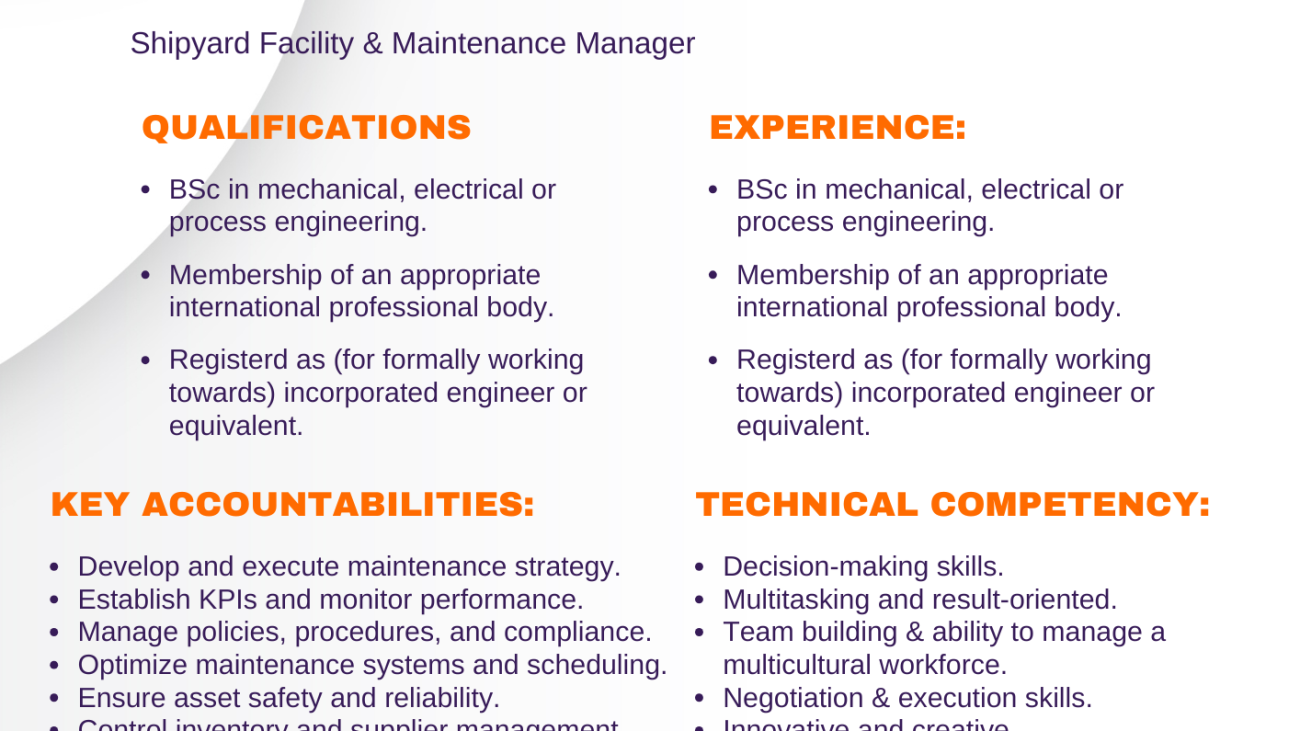
MAINTENANCE MANAGER

QUALIFICATION:

  • BSc in mechanical, electrical, or process engineering.

  • Membership of an appropriate international professional body.

  • Registered as (or formally working towards) Incorporated Engineer or equivalent.

EXPERIENCE:

  • 10 to 12 years’ experience in a similar role, at least five (5) years of which must have been in a senior maintenance role.

  • Experience in the execution of major projects and/or performance improvement projects in related industries.

LOCATION: QATAR

Key Accountabilities:

  • Develop and execute maintenance strategy.

  • Establish KPIs and monitor performance.

  • Manage policies, procedures, and compliance.

  • Optimize maintenance systems and scheduling.

  • Ensure asset safety and reliability.

  • Control inventory and supplier management.

  • Standardize repair and service processes.

  • Drive continuous improvement initiatives.

  • Lead and develop maintenance teams.

  • Oversee budget and procurement activities.

  • Manage stakeholders and contractors.

  • Promote health, safety, and well-being.

Technical Competency:

  • Decision-making skills.

  • Multitasking and result-oriented.

  • Team building & ability to manage a multicultural workforce.

  • Negotiation & execution skills.

  • Innovative and creative.

  • Leadership skills.

  • Project management skills.

REQUIREMENTS:

  • Candidate must have European nationality.

  • Candidate must have shipyard repair experience.

HOW TO APPLY:
Send your CV and Portfolio to this email address:
syed.waqas@manconint.com

A simplified crypto dashboard showing yield farming returns, NFT thumbnails, and a portfolio chart

Why yield farming, NFT support, and a clean portfolio UX matter — and how to pick a wallet that actually helps

Whoa! Crypto moves fast. Really? Yep, and sometimes it feels like you need a PhD just to read a token list. My instinct said this will be messy, but then the landscape surprised me in ways that were both clever and maddening. Initially I thought yield farming was just a higher-interest savings account for tokens, but then I realized the protocols, impermanent loss, and token incentives change the whole risk math—quickly and often very badly for the unprepared.

Here’s the thing. People who want neat, intuitive tools to manage crypto are not asking for bells and whistles. They want clarity. Shortcuts. A dashboard that doesn’t make your head spin when you check APYs across farms. They want NFTs to show up cleanly in their collection, not as a cryptic token ID that forces you to copy-paste into some explorer. And they want their portfolio to tell a story—profit, loss, exposure, tax events—without needing a spreadsheet. On one hand, UX improvements are cosmetic sometimes. On the other hand, a bad UI will hide risks until it’s too late.

Hmm… somethin’ else to add. Wallet choice isn’t just about security and seed phrases. It’s about the day-to-day friction. Transaction fees, chain switching, swap UX, the ability to stake or provide liquidity without juggling four different apps—those are real annoyances. Many wallets promise one-click access to DeFi, but behind the scenes you’re signing gas-heavy transactions that you didn’t fully parse. That part bugs me. You deserve to know what you’re signing, and to have a wallet that helps you make that call.

A simplified crypto dashboard showing yield farming returns, NFT thumbnails, and a portfolio chart

Picking a wallet that covers yield farming, NFTs, and portfolios — without the drama

Okay, so check this out—if you’re juggling yield farms, NFT purchases, and a diversified crypto stack, you want three core things: clarity on returns, clear ownership of NFTs, and consolidated portfolio analytics. On the returns side: APY numbers are seductive, but look deeper at rewards distribution, token emission schedules, and the liquidity depth of the pools you’re joining. Seriously? Yes—because high APY often means high token inflation, which can neutralize your earnings fast. On NFTs: metadata support matters. If your wallet doesn’t fetch and display metadata reliably, your “collection” is just a folder of token IDs. And portfolios—well, a little reconciliation goes a long way; you want realized vs unrealized P&L, not some fuzzy aggregate that lies to you.

Users often ask about wallets that balance safety and usability. Many lean toward wallets that integrate swaps, staking interfaces, and NFT galleries so they can manage everything in one place. One reasonably popular choice that people talk about for a clean, user-friendly interface is exodus wallet. It shows tokens and NFTs in a readable way, offers built-in exchanges for quick swaps, and provides a portfolio view that helps you gauge exposure without requiring you to export CSVs to a spreadsheet. I’m not saying it’s perfect; every wallet has trade-offs, but for a lot of folks the trade-offs are worth it when you simply want less friction and fewer surprises.

On yield farming specifics—think about slippage, routing, and composability. High APY on paper rarely accounts for the slippage you incur when entering or exiting a position, especially on low-liquidity pairs. Also, if the reward token has limited utility or weak price support, those shiny returns can evaporate. There are better strategies than blindly chasing the biggest percentage. Look for sustainable rewards: protocols with a long runway, strong treasury mechanics, and prudent tokenomics. If any of that sounds fuzzy, pause. Honestly, a lot of yield charts look great because they’re calculated under optimistic assumptions.

Oh, and by the way… liquidity mining incentives often shift. One day a farm is paying out in the native governance token; next week they’re switching to a partner token or reducing emissions. That transition can create windows of risk—liquidity withdrawals, sudden price pressure, or rushed migrations that burn less-informed liquidity providers. So, keep an eye on governance proposals and protocol updates. It’s not glamorous. But it’s real.

For NFTs, royalties and metadata hosting are the quiet, technical issues that bite later. If a marketplace or wallet doesn’t handle off-chain metadata properly, your NFT might not render in a gallery—even though ownership is intact on-chain. And if creators move metadata or use ephemeral hosting, image links can break. Some wallets proactively fetch images from decentralized sources or cache them; others don’t. That difference is the gap between a portfolio that “feels” whole and one that’s just an index of tokens.

Let’s talk security, briefly. Seed phrase safety and hardware wallet compatibility are table stakes. But also consider transaction previews, domain anti-phishing features, and permissions management. A wallet that shows which contracts can spend your tokens, and lets you revoke approvals easily, will reduce chances of long-term token drains. My instinct says: revoke approvals often. I know that sounds paranoid, but it’s practical. On a related note, some wallets integrate with hardware devices for signing; that’s a nice middle ground if you want cold-storage rigor with a pleasant UX.

Portfolio tracking—there’s nuance here. It’s tempting to use many separate analytics tools. But you’ll trade accuracy for fragmentation. Consolidation matters: a single view that accounts for cross-chain positions, wrapped versions of tokens, and NFT valuations gives you better decision-making power. Yet valuation is fuzzy. NFT prices are illiquid and subjective. Token peg mechanisms and wrapped assets add layers of complexity. So use portfolio numbers as directional, not gospel. They help you see trends, but they won’t replace careful position sizing.

Initially I thought automatic rebalancing was the silver bullet for non-professional investors, but then I realized auto-rebalancing can trigger tax events and generate gas costs that outweigh the benefits—especially on smaller portfolios. Actually, wait—let me rephrase that: auto-rebalancing is useful, but only when costs are lower than the value it brings. Think in ballpark terms and do the math before opting in. On the other hand, scheduled rebalancing can prevent emotional trading, which is a real advantage for many people.

And yeah, there are trade-offs you can’t avoid. Convenience usually means trade-offs in custody or reliance on integrated services. A wallet that makes staking a one-click process often routes you through third-party infrastructure. That can be fine, but know who you’re trusting. If you prefer minimizing third-party risk, consider a more modular setup—one dedicated wallet for custody, another set of interfaces for DeFi access connected via read-only or temporary sessions.

FAQ

What should I prioritize if I’m new to yield farming?

Start small. Focus on well-audited protocols with clear tokenomics and decent liquidity. Watch out for huge APYs tied to freshly minted tokens. Also, learn about impermanent loss before you commit large amounts. Use wallets and dashboards that show expected fees and projected slippage, so there are no surprises.

How do I make sure my NFTs display correctly in my wallet?

Check whether your wallet fetches off-chain metadata and supports common standards like ERC-721 and ERC-1155. If images don’t render, try refreshing metadata or using a wallet known for better gallery views. Keep backups of purchase receipts and transaction hashes—those are your proof of ownership even if images go missing.

Can I trust a single wallet to manage everything?

Many people do for simplicity, and that’s fine for everyday needs. But for large holdings or high-risk DeFi activity, consider splitting custody: one wallet for long-term holdings (preferably hardware), another for active trading and yield chasing. It’s a bit more work, but it’s also a hedge against single points of failure.