

You are standing in a coffee shop in the United States, trying to pay with one cryptocurrency while the funds you hold are denominated in another. A mobile wallet offers an exchange button, quotes a rate, and appears to solve the problem in seconds. The temptation is to treat this as a simple convenience feature. It is not. A wallet exchange combines asset conversion, transaction signing, liquidity, privacy decisions, and third-party risk inside one small interface. If the conversion fails, the problem may be an unfavorable price, a delayed blockchain transaction, a service provider’s policy, or a compromised phone.
The central misconception is that “exchange in wallet” means the wallet itself has become a fully private exchange. Usually, the wallet remains the software that controls or helps control your keys, while a separate exchange service, liquidity provider, or swap mechanism handles the conversion. That distinction matters. Self-custody can reduce dependence on a centralized custodian, but it does not remove counterparty risk, network surveillance, market volatility, or operational mistakes. A secure mobile crypto wallet is therefore best understood as a control panel for several systems, not as a magic privacy shield.
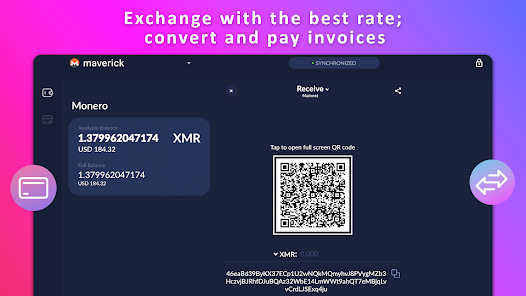
How an in-wallet exchange actually works
When a user exchanges Bitcoin for Monero, or one supported asset for another, the application must obtain a price and route the trade. In a common design, the wallet requests a quote from an external provider, displays the expected amount, and asks the user to approve one or more blockchain transactions. The wallet may sign the transaction locally, but the quote, routing, settlement, and fee calculation can still depend on outside infrastructure.
That creates several distinct stages: price discovery, transaction construction, authorization, broadcast, settlement, and delivery of the destination asset. Each stage has a different failure mode. A quote can expire. Network fees can change. A transaction can remain pending. The provider can reject a transaction because of jurisdiction, compliance screening, liquidity, or asset support. The receiving wallet may ultimately show fewer coins than the initial estimate because the rate moved or fees were deducted.
This is why the displayed exchange rate should not be the only number a user examines. The economically relevant figure is the final amount received after service fees, network fees, spreads, and possible slippage. Slippage is the difference between the expected execution price and the price actually obtained. It tends to matter more in thinner markets or during abrupt price movements. A “fee-free” exchange may still be expensive if the spread is wide.
The phrase “mobile wallet exchange” also hides a custody question. If a service asks the user to deposit funds to an address controlled by the provider and later sends back the converted asset, the user is temporarily exposed to counterparty and settlement risk. If the swap is structured through transactions that remain under the user’s control until completion, the custody profile may be different, but it is not automatically risk-free. The user still has to verify addresses, understand the route, and protect the signing device.
Privacy is not a single setting
Monero and Bitcoin illustrate why multi-currency support requires more than a list of coin icons. Monero is designed to obscure important transaction relationships through protocol-level privacy features. Bitcoin transactions, by contrast, are publicly visible on a transparent ledger, even when identities are not written directly into the transaction. A Bitcoin wallet can improve privacy through careful address management and spending practices, but it cannot make the Bitcoin ledger operate like Monero’s.
An exchange between the two assets may create a privacy boundary rather than eliminate one. The provider may see the source asset, the destination address, timing information, device or account metadata, and the transaction path it manages. Even if the blockchain transaction itself reveals limited personal information, network-level signals and service records can create a meaningful profile. Privacy therefore depends on the protocol, the wallet’s architecture, the provider’s data practices, the user’s network environment, and what happens before and after the exchange.
A useful mental model is to separate three kinds of privacy. Ledger privacy concerns what observers can infer from blockchain data. Network privacy concerns information exposed when the device communicates with nodes, servers, or exchange providers. Behavioral privacy concerns patterns created by repeated address use, predictable amounts, timing, account registration, and links to regulated platforms. Improving one layer does not necessarily improve the others.
For Bitcoin users, address reuse is especially revealing because it makes transactions easier to connect. Generating a fresh receiving address is helpful, but it is not a complete solution if a user later consolidates funds, repeatedly uses the same exchange provider, or links transactions to a known identity. For Monero users, protocol-level protections do not excuse poor device security or careless disclosure of addresses and payment information. Privacy reduces certain forms of visibility; it does not protect a phone that is infected or a seed phrase that has been photographed.
Security begins outside the exchange button
The strongest protection offered by a non-custodial wallet is generally control of the signing key. That protection disappears in practice if the recovery phrase is stored in a cloud note, entered into an unfamiliar website, or shared with someone claiming to be support. A legitimate wallet does not need a user’s recovery phrase to “verify” a transaction. Anyone who obtains it may be able to recreate the wallet elsewhere and move the funds.
Mobile devices introduce a concentrated attack surface. Screen overlays, malicious applications, SIM-related account attacks, clipboard replacement, unsafe backups, rooted or jailbroken operating systems, and fake wallet downloads can all undermine an otherwise sound protocol. Biometric unlocking can make daily use safer and more convenient, but biometrics usually protect access to the device or application; they do not replace the recovery phrase as the underlying authority.
Transaction verification deserves particular attention. Before approving a transfer, compare the asset, network, destination address, amount, and fee. For an exchange, also inspect the quoted output, expiry period, refund or failure procedure, and whether the provider requires an additional deposit. A familiar logo is not evidence that the transaction is safe. Address poisoning and phishing work precisely because users confirm the appearance of an interface instead of the details of the transaction.
For larger balances, a separate signing device or hardware wallet can reduce exposure to a compromised phone, although it adds setup complexity and can make urgent transfers less convenient. A practical division is to keep limited spending funds on a mobile wallet and use stronger isolation for savings. The correct boundary depends on the amount at risk, the user’s ability to maintain backups, and how frequently the funds must move.
Readers evaluating a privacy-focused multi-currency wallet can review an explanation of a wallet download here, but a download page should never substitute for independent verification. Obtain software from a source you can authenticate, check that the application and update path are genuine, and create the recovery backup before depositing meaningful funds. If the backup cannot be restored in a controlled test, the wallet is not operationally reliable, regardless of its feature list.
Common myths and the more accurate version
Myth: An exchange inside a wallet is always safer than using an exchange website
Correction: it may reduce copying addresses between applications and may preserve self-custody for part of the process, but safety depends on the actual routing model. An embedded provider can still hold funds temporarily, collect metadata, impose restrictions, or expose the user to smart-contract or service risk. Fewer visible steps do not necessarily mean fewer technical steps.
Myth: Multi-currency support means every asset receives the same privacy protection
Correction: privacy properties belong primarily to the protocol and the surrounding transaction environment. A wallet can present Monero and Bitcoin beside each other, but it cannot transfer Monero’s ledger characteristics to Bitcoin. It can offer better address handling, local key control, or privacy-oriented network options, yet the underlying chain remains a decisive boundary.
Myth: A confirmed transaction proves the exchange succeeded
Correction: confirmation proves that a particular blockchain transaction was accepted according to that network’s rules. It does not prove that the destination service has credited the converted asset, that the quote was fair, or that the receiving address was correct. Exchange completion requires checking the destination balance and, where relevant, the provider’s settlement status.
Myth: Privacy means avoiding all records
Correction: privacy is better described as reducing unnecessary exposure and improving control over who can infer what. Users in the US may still encounter tax, accounting, or service-reporting obligations depending on the activity and applicable rules. Technical privacy and legal compliance are separate questions. A wallet can help limit casual blockchain surveillance without making obligations disappear.
A reusable decision framework
Before using an in-wallet exchange, ask five questions. Who controls the funds during the swap? Where does the quote come from? What information leaves the device? What happens if the transaction is delayed or rejected? Can the received asset be independently verified afterward? These questions are more useful than judging an application by the number of supported coins or the smoothness of its animation.
For routine spending, convenience may reasonably outweigh small price differences. For a privacy-sensitive conversion, the user may instead prioritize a provider’s data minimization, transparent fees, address control, and clear failure handling. For a large transaction, a small test transfer can reveal whether the route, destination, and settlement process behave as expected. The test does not eliminate risk, but it limits the cost of an incorrect assumption.
The most important forward-looking signal is not simply whether wallets add more assets. It is whether they make the invisible parts of exchange visible: custody transitions, quote sources, data sharing, fee composition, and settlement status. If interfaces expose those mechanics clearly, users can make informed trade-offs. If they hide them behind a single “swap” button, convenience may grow while understanding shrinks.
FAQ
Does an in-wallet exchange require me to give up custody?
Not necessarily. Some designs keep the user in control of keys while transactions are arranged through an external provider. Others require a temporary deposit or account-based settlement. Read the transaction flow and determine who controls the funds at each stage rather than relying on the wallet’s branding.
Is Monero automatically private when used in a mobile wallet?
No. Monero provides protocol-level privacy properties, but device compromise, address disclosure, network metadata, unsafe backups, and third-party exchange records can still expose information. Privacy is a system outcome, not a single switch.
What is the safest first step before exchanging Bitcoin or Monero?
Verify the software source, secure and test the recovery backup, review the complete quote, and send a small test amount when the transaction is significant. Confirm the destination asset and address on the device itself, not only in a copied message or web page.
A mobile wallet can make crypto exchange more accessible, but accessibility should not be confused with simplicity. The exchange button compresses a chain of economic and security decisions into one gesture. Users who unpack those decisions—custody, liquidity, privacy layers, verification, and recovery—are better positioned to use multi-currency tools without mistaking convenience for protection.
Add a Comment